
“OUE H-Trust has done well in 1Q2017 achieving 18.2% higher DPS compared to 1Q2016. This is attributable to the increased contribution from the 563-room enlarged CPCA and higher occupancy at Mandarin Gallery. The operating environment is expected to remain challenging, and OUE H-Trust will continue to focus on active asset management to optimise the performance of its assets.”
Mr. Christopher Williams, Chairman
1.3 cents SGD (1Q 2017)
OUE H-Trust Posts 18.2% Increase in DPS for 1Q2017
- For 1Q2017, OUE H-Trust’s distributable income (DI) is also 19.1% higher than 1Q2016
OUE Hospitality Trust (OUE H-Trust), a stapled group comprising OUE Hospitality Real Estate Investment Trust (OUE H-REIT) and OUE Hospitality Business Trust (OUE H-BT), achieved DI of $23.5 million for the period from 1 January 2017 to 31 March 2017 (1Q2017), 19.1% higher than 1Q2016. OUE H- Trust’s distribution per stapled security (DPS) for 1Q2017 was 1.30 cents, 18.2% higher than 1Q2016.
Revenue and net property income (NPI) of $32.1 million and $27.4 million respectively were 6.4% and 4.3% higher than 1Q2016. Both the hospitality and retail segments of OUE H-Trust have recorded higher revenue and NPI for 1Q2017.
Mr. Christopher Williams, Chairman of OUE Hospitality REIT Management Pte. Ltd., the manager of OUE H-REIT (the REIT Manager), said: “OUE H-Trust has done well in 1Q2017 achieving 18.2% higher DPS compared to 1Q2016. This is attributable to the increased contribution from the 563-room enlarged CPCA and higher occupancy at Mandarin Gallery. The operating environment is expected to remain challenging, and OUE H-Trust will continue to focus on active asset management to optimise the performance of its assets.”
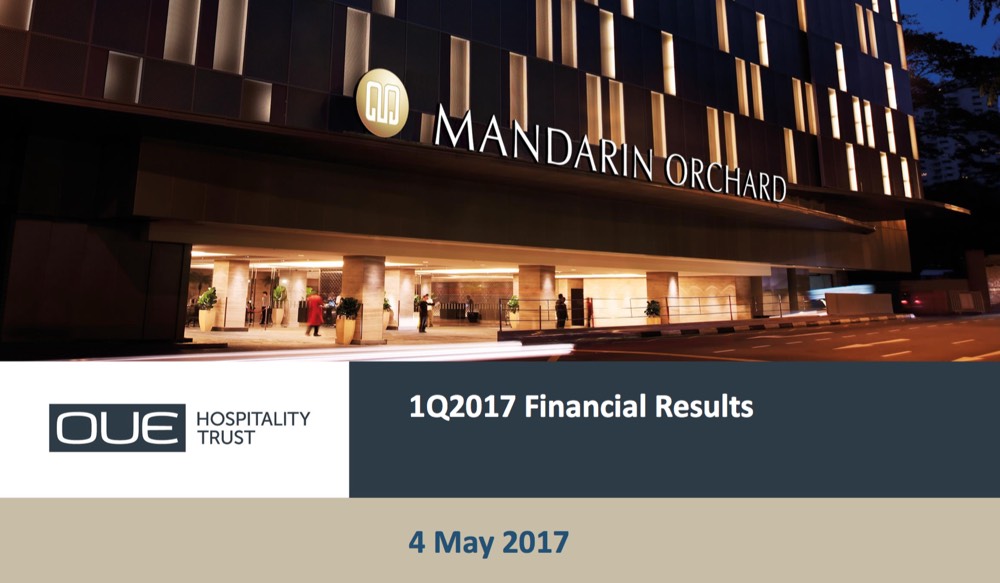
Mr. Chong Kee Hiong, CEO of the REIT Manager, said: “OUE H-Trust enjoyed higher income from the hospitality segment as the additional $1.6 million master lease income from the enlarged CPCA more than offset the $0.6 million lower contribution from Mandarin Orchard Singapore (MOS).”
Mr. Chong continued: “MOS achieved higher occupancy in 1Q2017 compared to 1Q2016, however the absence of biennial meetings, incentives, convention and exhibition (MICE) events such as the Singapore Airshow this year and a competitive market resulted in lower average room rates achieved. Overall, MOS’ revenue per available room (RevPAR) for 1Q2017 was $217, which was slightly lower than 1Q2016 RevPAR of $222. The lower room sales were partially mitigated by higher sales from the hotel’s food and beverage outlets and banquet.”
The 243-room extension to CPCA was acquired and commenced operation on
1 August 2016. As such, it is not meaningful to compare the 1Q2017 RevPAR for the 563-room enlarged CPCA with the RevPAR for the 320-room CPCA for 1Q2016.
Mr. Chong added: “The average occupancy of Mandarin Gallery in 1Q2017 has increased to 94.7% from 82.9% in 1Q2016. As a result, retail revenue for 1Q2017 was $1.0 million higher than 1Q2016. NPI for the retail segment was also 17.6% higher at $6.4 million.”
Outlook
Singapore Tourism Board (“STB”) reported a 3.4%1 year-on-year increase in international visitor arrivals in the first two months of 2017. For the full year 2017, STB has forecast 0% to 2% growth in international visitor arrivals at 16.4 million to 16.7 million.2
Though the economic outlook has improved, there are still risks to achieving sustained recovery. As such the tourism industry continues to face headwinds in the near term as consumers and corporates are likely to be conservative in their travel expenditures. The increased rooms supply in Singapore had created a highly competitive market environment and this would likely persist as more supply is expected in 2017 before tapering in 2018. To support the tourism industry and in an effort to boost tourism, the Singapore government has set aside $700 million3 in a Tourism Development Fund to be invested from 2016 to 2020. In addition, Changi Airport Group, Singapore Airlines and STB have announced that they will jointly invest $34 million to promote Singapore as an attractive stopover and twinning destination to travellers globally.4 Changi Airport’s Terminal 4 is expected to be operational in the second half of 2017.5 Higher air passenger traffic through Changi Airport could potentially benefit Singapore’s hospitality sector.
The asset enhancement programme on 430 rooms of Mandarin Orchard Singapore (“MOS”) and a programme to renovate and increase the meeting facilities in MOS have been completed. The enhancement of MOS’ meeting facilities will allow it to attract and cater to a wider range of banquet and conference demand. For the enlarged CPCA, the ramping up of operations continues in a challenging market.
The retail scene in Singapore remains challenging. To partner tenants towards success, the structure of leases for some tenants feature lower base rent and higher turnover rent compared to previous leases for the same units.
We will continue to actively seek growth opportunities and yield accretive acquisitions from our Sponsor and third parties.
IMPORTANT NOTICE
The value of stapled securities in OUE Hospitality Trust (“Stapled Securities”) and the income derived from them, if any, may fall or rise. Stapled Securities are not obligations of, deposits in, or guaranteed by, OUE Hospitality REIT Management Pte. Ltd. (as the manager of OUE Hospitality Real Estate Investment Trust), OUE Hospitality Trust Management Pte. Ltd. (as the trustee-manager of OUE Hospitality Business Trust) (collectively, the “Managers”) or any of their affiliates. An investment in Stapled Securities is subject to investment risks, including the possible loss of the principal amount invested. The past performance of OUE Hospitality Trust is not necessarily indicative of the future performance of OUE Hospitality Trust.
This press release may contain forward-looking statements that involve risks and uncertainties. Actual future performance, outcomes and results may differ materially from those expressed in forward-looking statements as a result of a number of risks, uncertainties and assumptions. Representative examples of these factors include (without limitation) general industry and economic conditions, interest rate trends, cost of capital and capital availability, competition from similar developments, shifts in expected levels of property rental income, changes in operating expenses (including employee wages, benefits and training costs), property expenses and governmental and public policy changes. You are cautioned not to place undue reliance on these forward-looking statements, which are based on the Managers’ current view of future events.
Investors should note that they will have no right to request the Managers to redeem or purchase their Stapled Securities for so long as the Stapled Securities are listed on the SGX-ST. It is intended that holders of Stapled Securities may only deal in their Stapled Securities through trading on the SGX-ST. The listing of the Stapled Securities on the SGX-ST does not guarantee a liquid market for the Stapled Securities.
This press release is for information only and does not constitute an invitation or offer to acquire, purchase or subscribe for Stapled Securities.